
Conducting a clinical trial in Colombia involves more than obtaining INVIMA approval.
Foreign pharmaceutical companies, biotech companies and CROs must coordinate regulatory approval, ethics review, site qualification, healthcare-service habilitation, investigational-product logistics, safety reporting, data protection and contractual allocation of responsibilities.
A deficiency in any of these areas may affect submission, site activation or the ongoing operation of the study.
This guide explains the principal Colombian regulatory issues foreign sponsors and CROs should evaluate before conducting a clinical trial in Colombia.
Planning a Clinical Trial in Colombia?
We can review your proposed Colombian structure before submission or site activation and identify regulatory, contractual and operational issues requiring local action.
When Does a Drug Clinical Trial in Colombia Require INVIMA Approval?
In Colombia, the National Institute for Food and Drug Surveillance (INVIMA) is the competent health authority for the evaluation and authorization of clinical trials involving medicines in human subjects.
Under the current Colombian framework, Phase I, Phase II, Phase III and interventional Phase IV drug studies intended to be conducted in Colombia must be submitted to INVIMA through the Protocolos en Línea platform. See INVIMA Guide ASS-RSA-GU039, Version 6, section 3.1 (implemented 14 February 2026).
Before the regulatory submission is filed, the study must also have been reviewed by a Research Ethics Committee (Comité de Ética en Investigación or CEI) associated with an institution certified in Good Clinical Practices.
Foreign regulatory approval does not replace the Colombian process. Authorization by the FDA, EMA or another foreign regulator does not eliminate the need to comply with the Colombian regulatory pathway.
Medical-device clinical investigations follow a different regulatory route and should therefore be assessed separately.
For foreign sponsors: The Colombian regulatory pathway should be confirmed before adapting the global dossier or committing to a local site-activation timeline.
Before Selecting a Colombian Research Site, What Should a Sponsor Verify?

Site qualification in Colombia requires more than confirming that the institution has experience conducting clinical research.
A foreign sponsor should distinguish between at least two separate regulatory controls.
First, the research institution must comply with the Good Clinical Practice requirements applicable to clinical research with medicines and, where required, hold the corresponding certification issued by INVIMA.
Second, if the institution acts as a healthcare provider, the sponsor should verify that the healthcare services actually required to perform the protocol are duly habilitated under the Colombian healthcare-provider framework.
These are separate regulatory analyses. Resolution 2378 of 2008 establishes the Good Clinical Practice framework, while healthcare-service habilitation is addressed separately under Resolution 3100 of 2019, as amended. A site may therefore require review both from the clinical-research perspective and from the healthcare-service habilitation perspective. See the official INVIMA legal compilation of Resolution 2378 of 2008 and the Ministry of Health text of Resolution 3100 of 2019.
Why this matters: Discovering a site deficiency after the institution has already been selected, contracted or incorporated into the global study timeline may create avoidable delays and contractual issues.
How Should Sponsor and CRO Responsibilities Be Allocated in Colombia?

Colombian regulation recognizes that a Contract Research Organization (CRO) may perform one or more functions related to the clinical trial on behalf of the sponsor. Resolution 2378 of 2008, including its technical annex, addresses the CRO role and the applicable Good Clinical Practice framework; see the official legal text.
In practice, a CRO may participate in regulatory submissions, site coordination, monitoring, pharmacovigilance, document management and other operational activities.
However, the delegation of functions should be clearly documented. The sponsor–CRO agreement should specify which party is responsible for each regulatory and operational obligation arising in Colombia.
Particular attention should be given to responsibilities involving INVIMA submissions, Ethics Committee communications, amendments, informed-consent updates, safety reporting, investigational-product imports, biological-sample exports, monitoring, annual reporting and study closure.
Practical consideration for foreign sponsors
A Colombian Sponsor–CRO Responsibility Matrix can help identify whether the allocation contained in a global CRO agreement actually covers the obligations that arise under Colombian regulation.
Discuss Your Colombia Clinical Trial
Share your study stage and the Colombian regulatory questions you need help assessing.
What Should Be Included in the Initial INVIMA Clinical Trial Submission?

The initial submission to INVIMA requires a structured regulatory dossier.
According to the current INVIMA guidance identified in the regulatory review, the submission may include, among other documents:
- The clinical protocol in Spanish and English
- The applicable INVIMA verification form
- Ethics Committee documentation and approval
- The Investigator's Brochure
- Informed-consent documents
- Site and investigator documentation
- The applicable insurance policy
- Good Manufacturing Practice documentation for the manufacturer and
- Technical and quality documentation relating to the investigational product.
See INVIMA Guide ASS-RSA-GU030, Version 5, section 3.1 and its initial-submission document list (the direct PDF). The exact documentation should be confirmed for the specific study and product before filing; current portal forms should be checked rather than relying on older form codes.
Commercially important: A sponsor should not treat the Colombian submission as a simple local translation of the FDA or EMA dossier. Local ethics, insurance, site and product-documentation requirements need to be mapped separately.
What Regulatory Obligations Continue After INVIMA Approval?

INVIMA approval is not the end of the Colombian regulatory process.
During the conduct of the study, the sponsor and, where applicable, the CRO must continue to manage regulatory obligations relating to amendments, new sites, new investigators, informed-consent changes, safety information and other changes affecting the approved study.
Ongoing obligations may also involve annual reports, pharmacovigilance, investigational-product traceability, monitoring, quality assurance and maintenance of essential documentation.
Amendments, new sites, new investigators and informed-consent changes must be assessed under INVIMA’s applicable submission and approval procedures before implementation. The official INVIMA Clinical Trials portal lists the applicable instructions and formats for amendments, annual reports, study closure, imports, biological-sample exports and annual safety reports.
At the end of the study, the sponsor must also address the regulatory closure process, including final documentation and investigational-product accountability.
Safety reporting requires particular attention
For serious adverse events occurring in Colombia, the investigator must report to the sponsor or CRO and the Research Ethics Committee within 24 hours of becoming aware of the event. Article 3 of Resolution 2011020764 of 2011 requires the sponsor or CRO to report to INVIMA within seven business days from the investigator’s first report. INVIMA’s ACOM-INS131 instruction, Version 1 (implemented 1 June 2026) describes this period by reference to the date the sponsor is notified. Follow-up and final reporting requirements also apply.
For global sponsors: Colombian safety-reporting obligations should be incorporated into the global pharmacovigilance SOPs and escalation calendar.
How Should Investigational Products and Biological Samples Be Managed Across Borders?

Investigational-product logistics and biological-sample transfers should be addressed early in the Colombian regulatory strategy.
INVIMA has specific procedures for applications related to the importation of clinical-trial supplies and the exportation of biological samples associated with clinical-research protocols. The official Clinical Trials portal lists the relevant instructions and forms, including ACOM-INS57, ACOM-FOR164 and ACOM-FOR165.
The investigational product must remain identifiable and traceable throughout the study, including records concerning shipment, receipt, return and destruction.
Where biological samples will be exported, the relevant documentation should address matters such as the type of sample, purpose of the analysis, storage conditions, destination and the party responsible for the process.
The regulatory strategy should also be aligned with the protocol and informed-consent documentation.
In practice, sponsors should address two separate workstreams
Investigational product
- Importation
- Storage
- Receipt
- Accountability
- Return or destruction
Biological samples
- Type of sample
- Purpose of analysis
- Destination
- Storage conditions
- Responsible party
- Confidentiality
- Informed-consent coverage
What Should Foreign Sponsors Know About Clinical Data, Medical Records and Cross-Border Transfers?

Clinical trials involve health information and other categories of sensitive personal data that are subject to Colombian data-protection requirements under Law 1581 of 2012, particularly Articles 5, 6 and 26.
Foreign sponsors should identify the roles of the sponsor, CRO, research site and other providers in the processing of personal data and determine whether the relevant data flows constitute international transfers or international transmissions.
This distinction can be legally relevant under the Colombian data-protection framework. Transfers and transmissions require separate legal analyses under Decree 1074 of 2015, Articles 2.2.2.25.1.3, 2.2.2.25.5.1 and 2.2.2.25.5.2.
Medical records are also subject to confidentiality rules under Resolution 1995 of 1999, Articles 1 and 14, while biological samples, genetic studies, pharmacogenomic analyses and future uses of samples should be appropriately reflected in the protocol, informed consent and regulatory documentation.
Where samples are transferred outside Colombia, the regulatory requirements applicable to their export must also be considered.
For international sponsors: Compliance with GDPR, HIPAA or a global privacy policy does not by itself resolve the Colombian legal analysis of clinical-data flows.
Why Do Advanced Therapies Require an Early Colombian Regulatory Assessment?

Cell therapies, gene therapies, CAR-T products and other highly personalized treatments may require a more complex Colombian regulatory analysis.
Advanced therapies may raise additional issues relating to product classification, manufacturing, quality, importation, biological samples, genetic information and long-term safety.
For these products, a sponsor should not assume that the regulatory classification or pathway adopted by FDA or EMA will automatically determine the Colombian approach.
An early regulatory assessment may therefore be particularly valuable before the sponsor finalizes the Colombian operational structure, selects sites or commits to an importation and sample-handling strategy.
Advanced-therapy sponsors should address classification and regulatory pathway questions before site activation, rather than after the Colombian study structure has already been established.
Do Not Treat the Colombian Submission as a Translation Exercise
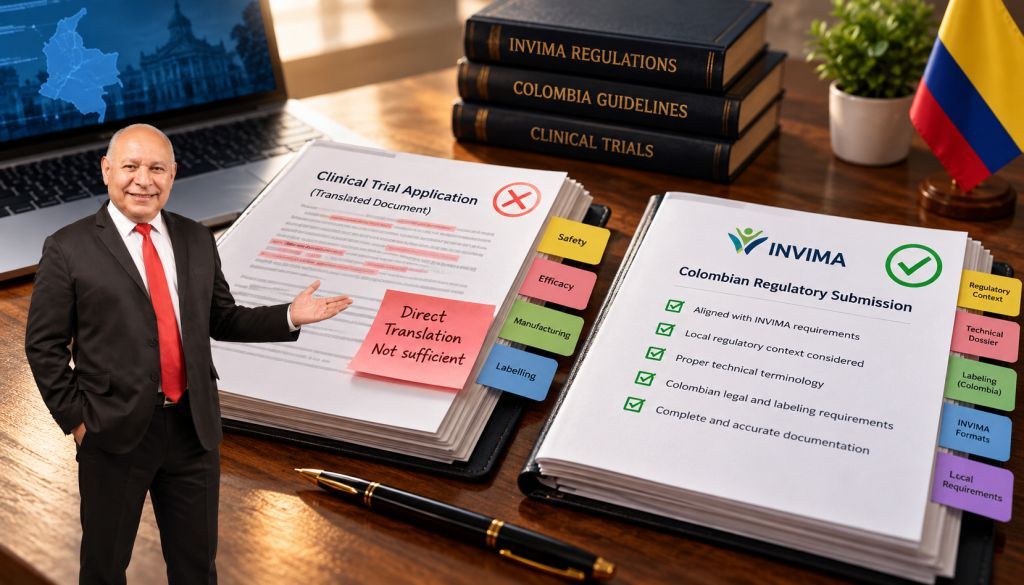
A Colombian clinical-trial submission should not be approached as a simple translation or administrative adaptation of an FDA, EMA or other foreign regulatory dossier.
Local requirements must be mapped independently, particularly in relation to Ethics Committee documentation, informed consent, insurance, site and investigator documentation, manufacturing evidence, and technical and quality information relating to the investigational product.
For foreign sponsors: the Colombian submission strategy should be reviewed before filing to identify local gaps that may not be addressed in the global regulatory package.
Planning a Clinical Trial in Colombia? Request a Regulatory Readiness Assessment

Nieto & Nieto Lawyers advises foreign pharmaceutical companies, biotech companies, sponsors and CROs on the Colombian legal and regulatory workstream of clinical trials.
A Colombia Clinical Trial Regulatory Readiness Assessment can be used to identify legal and regulatory issues before submission or site activation, including:
- INVIMA regulatory pathway
- Site qualification
- Sponsor–CRO responsibility allocation
- Ethics Committee requirements
- Investigational-product logistics
- Biological-sample exports;
- Clinical-data flows
- Insurance and indemnity issues
- Clinical Trial Agreements
- Ongoing Colombian regulatory obligations.
Official Sources and Regulatory References
- INVIMA Guide ASS-RSA-GU039, Version 6, section 3.1 — drug-trial phases, prior Ethics Committee review and Protocolos en Línea.
- INVIMA Guide ASS-RSA-GU030, Version 5 — initial submission documents; see also the direct PDF.
- Resolution 2378 of 2008 — Good Clinical Practice, site qualification and CRO framework.
- Resolution 3100 of 2019 — healthcare-service habilitation framework, as amended.
- Resolution 2011020764 of 2011 and INVIMA Instruction ACOM-INS131, Version 1 — serious adverse-event reporting.
- INVIMA Clinical Trials portal — formats, procedures and guides — amendments, annual reports, closure, imports and sample exports.
- Law 1581 of 2012 — sensitive personal data and international transfers.
- Decree 1074 of 2015 — transfers and transmissions of personal data.
- Resolution 1995 of 1999 — medical-record confidentiality.